Giving a forgotten future physical form
In the first part of this essay, I explored the fascination with forgotten places, memories and the worlds we leave behind that has shaped Ankaris.
But there's another part of the question.
Why do I keep returning to these ideas, and why do I feel compelled to give them form through paintings?
The importance of things left unexplained
I don't want every Ankaris painting to tell a complete story.
In fact, I think explaining everything would diminish much of what interests me about the world.
I prefer the idea that we're encountering fragments of a much larger history. A place, an object, an event, or perhaps an ordinary moment in somebody's life.
We arrive without knowing everything that came before. We see the evidence, but we don't necessarily understand it.
That's what archaeology does. It reconstructs the past from incomplete information.
Ankaris is something similar, except the civilisation we're investigating belongs to an imagined future.
Hence the phrase I've used to describe the project for many years:
The past archaeology of a forgotten future.
I like the contradiction. It suggests a future that has already happened, whose achievements have already begun to disappear from memory.
It also leaves room for the viewer.
I can provide the place, the atmosphere and some of the evidence. But I want you to bring your own imagination to it.
You might see something in a painting that I never consciously intended, and I'm perfectly happy with that.
Scale, distance and being human
Scale has always been central to Ankaris.
I love the experience of standing somewhere and feeling dwarfed by the environment. It might be a mountain range, an immense industrial structure or a landscape stretching away towards the horizon.
There's a peculiar combination of emotions in that experience.
You feel very small, but at the same time, extraordinarily aware of being there.
The same feeling can exist in a painting.
A tiny human figure standing beside the remains of an immense spacecraft tells us something about the machine, but perhaps also something about ourselves.

Wadi Akra
We build things, explore places, create histories and imagine futures. Yet we're temporary occupants of a much larger universe.
Our achievements may outlive us, but not necessarily forever.
I don't regard that as an entirely pessimistic thought. There's wonder in it, too.
The universe is immense, time is immense, and here we are, briefly able to look around and appreciate it.
Perhaps that's one of the reasons I keep returning to these images.
Why paintings?
After spending much of my professional life creating environments and imaginary worlds for films, Ankaris became somewhere I could explore entirely on my own terms.
There was no production brief, no director waiting for a design, and no requirement to make the world understandable in ninety minutes.
I could follow an idea simply because I found it interesting.
The project began more than two decades ago with a small watercolour painted one Sunday afternoon in Wellington, New Zealand, not long after I started working on The Lord of the Rings.
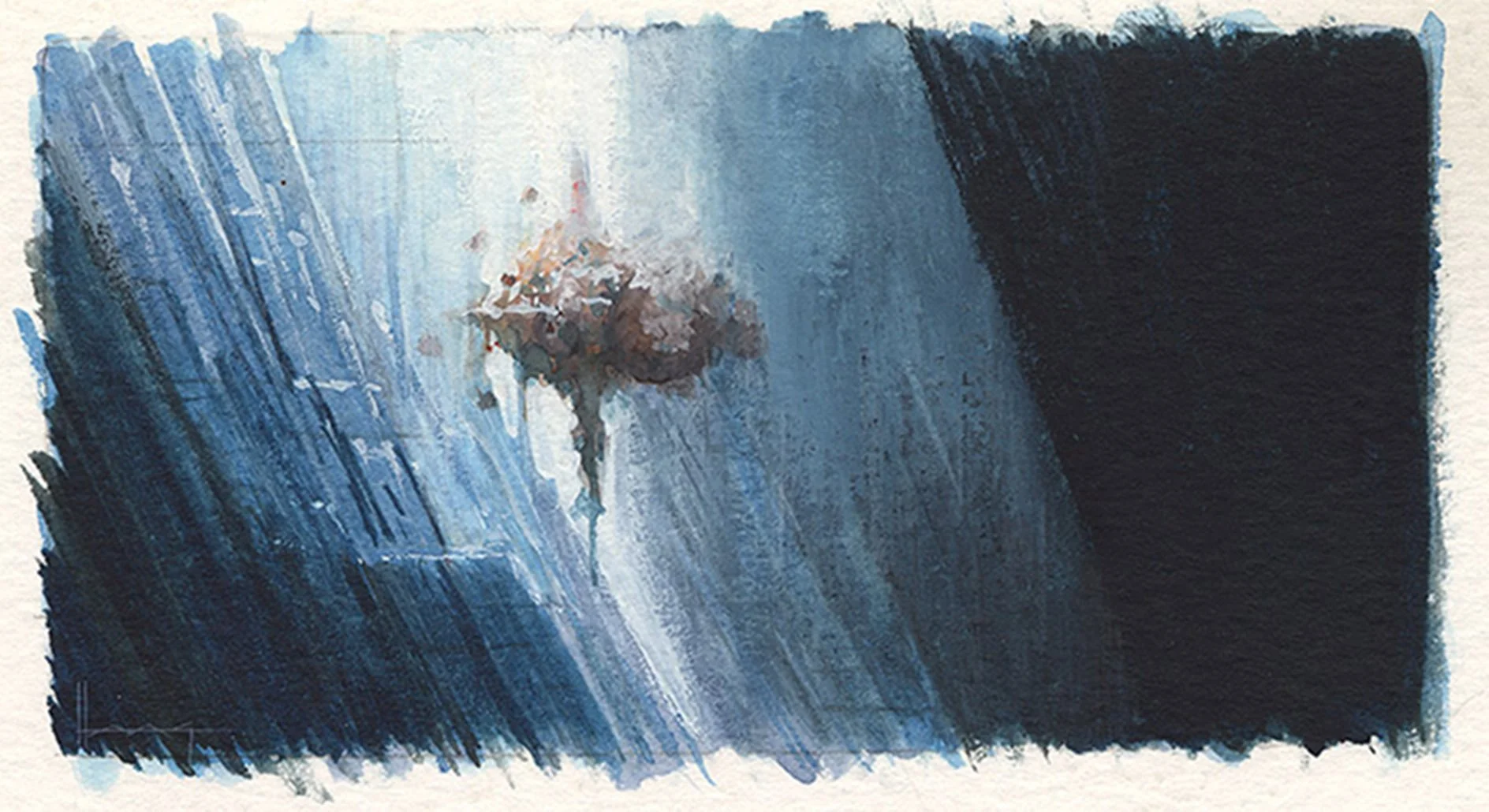
Levitation
Original watercolour sketch
2001
Since then, it has grown through paintings, drawings, imagined histories, spacecraft, landscapes and countless ideas developed between other commitments.
Why continue making physical paintings of a fictional world?
I think part of the answer is that I want these imaginary places to have a physical existence.
An oil painting is an object. It occupies space. It has a surface, scale, texture and a relationship with light that can't be fully communicated through a photograph on a screen.
The world may be imaginary, but the painting is real.
I like that distinction.
It's one thing to imagine an enormous wreck disappearing into the distance. It's another to stand in front of a painting and experience something of that distance for yourself.
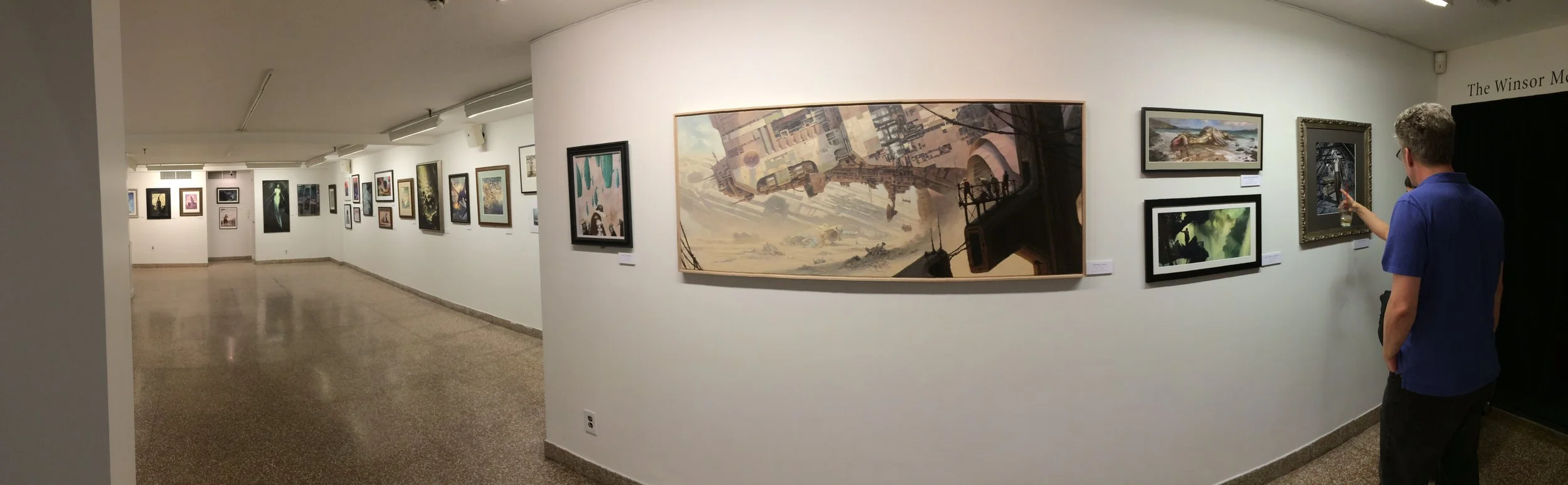
Sky Burial 2 hanging in the Spectrum Exhibition at the Society of Illustrators NY 2014
In a small way, the painting becomes an artefact from the world it depicts.
A world I haven't finished discovering
I don't know whether Ankaris will ever be finished.
I'm not even sure I want it to be. Working on this project for the rest of my life will barely scratch the surface. I have too many ideas and not enough life left to see them through!
Over the years, ideas have changed. Paintings have been revised. New discoveries within the fictional world have suggested entirely different directions.
Sometimes a painting raises more questions than it answers and sparks new ideas for me.
I spent a great deal of my career helping other people bring their imaginary worlds into existence. Ankaris is the one I keep returning to because its questions remain my own.
And perhaps that's the simplest explanation for why I continue creating it.
I'm still curious.
I still want to know what lies beyond the edge of the painting, where those enormous ships came from, who lived among them, and what happened to the people whose stories have been almost entirely forgotten.
I still want to stand somewhere unfamiliar, look out across a vast landscape, and experience that feeling I had as a child opening a science-fiction art book for the first time.
The sense that somewhere, impossibly, this place might exist.
And that there is so much more to discover.
That's why Ankaris.
